If you live in London, Ontario, you know how a backyard can turn into a shallow pond after a spring thaw or a late summer storm. Water lingers in low spots, the lawn squishes underfoot for days, and mosquitoes take full advantage. Beyond the nuisance, persistent standing water stresses turf, drowns perennials, heaves patios, and can push moisture toward your foundation. Fixing it is not about one silver bullet. It is about understanding how your property handles water, then applying the right combination of grading, storage, and subsurface drainage.
I have spent two decades troubleshooting backyard drainage in Southwestern Ontario. The same patterns appear over and over: flat lots with heavy clay subsoils, downspouts dumping water at the base of the wall, buried construction debris that acts like a dam, and lawn surfaces that look level but pitch the wrong way over a long run. When you respect how water wants to move through London’s soils and freeze-thaw cycles, you can turn a swampy yard into a yard that dries out a day after rain.
Why London’s backyards struggle with water
Start with the soil. Much of London sits on clay and clay loam. Clay holds water tightly, drains slowly, and compacts under foot traffic and equipment. When clay gets saturated, it sheds water laterally rather than letting it soak down, so depressions fill quickly and stay wet. Sand pockets exist on some ridges and infill areas, but most subdivisions, especially those built in the past 40 years, were graded on compacted fill. The surface looks smooth, but just under the sod is a dense layer that behaves like a saucer.
Freeze-thaw makes the story more interesting. In winter, frost penetrates the ground, sometimes 30 to 45 centimetres in a typical London winter, and deeper in extreme cold with little snow cover. Frost creates an impermeable layer. When we get a midwinter melt, the water has nowhere to go and pools on the surface. In spring, as the frost retreats, turf roots are stressed, and low spots show themselves in dramatic fashion.
Add storm intensity. A July cloudburst can drop 25 to 40 millimetres in an hour. Downspouts that concentrate roof runoff can send hundreds of litres to a small patch of lawn in minutes. If grade near the house is flat or negative, that water seeks the path of least resistance, including along the foundation wall.
Finally, consider subdivision grading. New homes are built to a lot grading plan that moves runoff to the street or a rear swale, sometimes to a rear yard catch basin. Over time, landscaping projects, fence lines, and garden beds block those shallow swales. Topdressing the lawn raises the centre while edges stay low. A decade later, the original drainage intent is gone.
How to diagnose your yard without guesswork
You do not need expensive equipment to build a clear picture of why water sits. You need eyes, a tape measure, a string line, and a day or two of patience.
- After a rainfall, photograph where water sits, how deep, and how long it takes to disappear. Mark the shoreline with landscape flags or small stakes so you can see patterns once the surface dries. Walk the perimeter and check downspouts. Note where each discharges, the roof area it serves, and the distance to the foundation and any swales. Use a string line and a level to measure slope. Over 3 metres, you want roughly 6 to 8 centimetres of fall away from the house. More is fine if the transition is smooth. Probe the soil with a shovel or soil auger. Note if you hit compacted subsoil a few centimetres below the sod, if water seeps into the test hole, and how fast. A simple percolation test helps: fill a 20 cm deep hole with water twice, time the drop on the second fill. If it falls less than 1 cm per hour, you have slow-draining soil. Look for obstructions. Retaining timbers, old tree roots, patio edges, and raised garden beds often act as dams that trap shallow surface flow.
Those observations tell you where to intervene and how aggressive you need to be. If water lingers for a day then dissipates, grading and downspout management may be enough. If a puddle holds for three or four days after a normal rain, especially on clay, you will likely need subsurface drainage such as french drains.
Respect the hierarchy: source, surface, subsurface
Fixes work best in a sequence. First, control the source of water. Second, reshape the surface so it moves excess water to an appropriate outlet. Third, add subsurface drains if necessary to move water through the soil profile. Skipping to perforated pipe while downspouts still dump against the house wastes time and money.
Control what you can at the source
Downspouts are the largest controllable water source in most backyards. A single 90 square metre roof face can generate 2,700 litres of runoff in a 30 mm storm. Do not aim that at a flower bed and hope mulch takes care of it. Extend downspouts well into the yard, 2 to 3 metres if possible, so water disperses. Where property lines are tight, use hinged extensions you can move for mowing. Consider a rain barrel for one or two spouts to shave peak flows during storms. In London, check that any sump pump discharge runs to the lawn or a dedicated storm lead, not the sanitary. City by-laws typically prohibit sump connections to sanitary sewers to reduce inflow, and many neighbourhoods have storm laterals you can use with proper permits.
Roof leaders that formerly connected to weeping tiles are a common headache in older homes. Disconnect them if they still tie into the foundation system. Redirecting to grade protects the weeping tiles and reduces the risk of foundation saturation.
Get the grade right
Surface grading has the best return on investment in backyard drainage. The goal is simple: create a consistent, gentle slope away from the house and toward a receiving feature such as a swale, a rear catch basin, or a side yard that drains to the street. In most London lots, 2 to 3 percent slope, about 2 to 3 cm per metre, is ideal. Near the foundation, you want more fall in the first 1.5 to 2 metres, usually 10 to 15 cm, as long as you maintain a safe clearance below siding and sill plates.
In practice, this means shaving soil from high spots and using it to fill shallow depressions. Do not be afraid to remove sod, correct subgrade, then reinstall new sod. Topdressing with a couple of centimetres of triple mix can help minor birdbaths, but if you have more than 4 or 5 cm of water depth, topdressing will not cut it. You need to address the subgrade.
If your yard shares a swale with neighbours, respect the shared elevation. I have seen well-intentioned landscaping on one lot block a swale and flood two other yards. In London, altering a subdivision swale that affects drainage off your lot can require permission. When in doubt, speak with the City’s Development Services or consult drainage contractors in London, Ontario who know the local grading patterns.
Swales, not trenches
A swale is a shallow, broad channel that encourages water to move at walking speed. Think a 1 to 2 metre wide dip, 10 to 15 cm deep from edge to centre, feathered smoothly into the lawn. When properly shaped and sodded, a swale disappears under normal conditions and only reveals itself during storms. Swales handle a surprising amount of flow install french drain london without erosion if the slope stays gentle and the turf is healthy.
A narrow trench erodes, collects debris, and becomes a maintenance headache. Unless you line a narrow ditch with rock and fabric, it will turn ugly and still not move water well. Aim for broad and shallow. If you have a fence crossing a swale, notch the bottom by an extra 5 to 8 cm over a short run so water can pass under.
Where a dry well makes sense
In tight urban lots, there may be no practical surface outlet. A properly built dry well can provide storage while water slowly percolates into the subsoil. A dry well is essentially an underground tank made of clean stone or a plastic chamber surrounded by stone, wrapped in geotextile to keep soil out. It only works when the surrounding soil has at least modest percolation and when the seasonal high water table sits well below the bottom of the well. In London’s dense clays, dry wells are hit or miss. A percolation test is mandatory before you commit. If the soil swallows less than 1 cm per hour, a dry well is not a good investment.
The role of french drains in London backyards
French drains, sometimes called trench drains or perforated pipe drains, shine when you have persistent low spots over heavy soils or need to intercept subsurface flow that keeps a yard soggy. In our region, you also see them installed as curtain drains upslope of a patio or pool to intercept water moving through a slope.
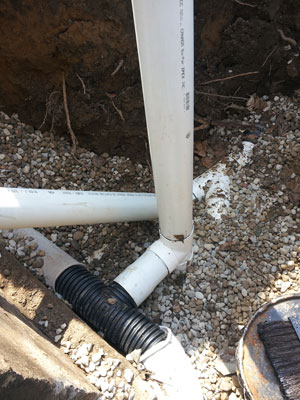
A basic french drain is a perforated pipe laid in a trench filled with clear stone, wrapped in a non-woven geotextile to prevent fines from clogging the system. The pipe must have a positive slope to an outlet, even if modest, and the trench must be deep enough to sit below the wet zone you are trying to drain.
The most common mistake I see is a trench filled with coarse stone and no fabric, or a pipe installed dead level in a backyard that has no outlet. It works for a season or two, then becomes a buried aquarium. When built thoughtfully, french drains in London, Ontario perform well for a decade or more with minimal maintenance.
How to build a french drain that lasts
- Call Ontario One Call before you dig. It is free, and legally required, and you will avoid cutting cable, gas, or hydro. Mark private lines like irrigation separately. Establish the outlet. A french drain needs a real destination: a rear yard catch basin, a storm lateral, a daylit outlet at a low point, or a dry well if soil allows. Confirm the outlet elevation first, then work back. Set slope and depth. Aim for at least 1 percent slope on the pipe if you can. In flat yards, 0.5 percent is workable over short runs if the trench is straight. Depth is dictated by the problem, but 30 to 45 cm to the top of the stone is common in lawns. Go deeper if you are trying to lower a perched water table. Use the right materials. Non-woven needle-punched geotextile, not landscape fabric, around the stone and pipe. 19 mm clear crushed stone, washed clean. Perforated pipe with a true filter sock only if the surrounding stone is not wrapped in geotextile. Solid pipe for the outlet run. Finish with a turf-friendly surface. Cap the trench with 5 to 8 cm of topsoil over stone, or use a narrow strip of river rock if you like a visible path. Keep the final grade smooth so the lawn mower glides without scalping.
Installed correctly, a french drain relieves water in a stubborn low spot within hours of a storm. On a clay lot with a wet depression the size of a car, I typically run a grid pattern of two parallel trenches feeding a collector that exits to a rear catch basin. The pattern depends on the shape of the low area and the available outlet. There is no one-size schematic.
Weeping tiles and the foundation connection
Homeowners often confuse backyard drainage with the weeping tiles around the foundation. Weeping tiles, or foundation drains, are perforated pipes at the bottom of the foundation wall intended to relieve hydrostatic pressure and move water to a sump or storm connection. In London, many post-1970 homes have plastic weeping tiles that connect to a sump pit with a pump that discharges to the yard or a storm lateral. Older homes may have clay tiles that can clog or collapse.
Backyard water management aims to reduce the load on weeping tiles by moving roof and surface water away from the foundation. Do not tie a backyard french drain into weeping tiles unless a qualified professional confirms the system design and connection. In many cases, adding more water to the foundation system makes life worse. If you suspect your weeping tiles are compromised because the sump runs constantly or you see water seeping into the basement wall after a normal rain, call a specialist. Search for weeping tiles London, Ontario and verify the contractor’s approach includes camera inspection and clear separation of roof runoff from the foundation system.
Local constraints that change the plan
Every fix must fit local rules and the site context. In London:
- You must request underground locates through Ontario One Call before you break ground with a shovel or a mini-excavator. Discharge of sump pumps and downspouts to the sanitary sewer is typically forbidden. Many neighbourhoods have a storm system you can legally connect to with permits and inspection. If your block lacks a storm lateral, plan for lawn discharge. Altering drainage so that water is directed onto a neighbour’s lot can trigger disputes and, in some cases, enforcement. If you modify a shared swale, get alignment with adjacent owners. If your property backs onto a storm management block, respect the easement conditions. For new constructions, the lot grading certificate controls the baseline. For existing homes, general landscaping does not require a permit, but hardscape projects near the property line, retaining walls over a certain height, and connections to municipal storm services can.
Good drainage contractors in London, Ontario work within these guardrails every week. If your plan includes connecting to a municipal storm lead or altering a shared swale, bring in a contractor early. You do not want to build a system twice.
What it costs, realistically
Costs vary with access, soil conditions, and scope. As a range from recent projects in the city:
- Regrading a standard backyard with machine access and new sod, without hardscape removal, often runs 10 to 20 dollars per square foot of disturbed area. A 900 square foot rear lawn might come in at 9,000 to 18,000 dollars if you need to peel sod, correct subgrade, and lay new sod, less if spot corrections suffice. Adding two or three long downspout extensions with splash pads and minor swale shaping typically lands between 600 and 2,000 dollars. A french drain serving one low spot with a clear outlet, say 12 to 20 metres of trench in open lawn, commonly prices between 3,000 and 7,000 dollars. Add more if access is tight or if you need to cross patios or tree roots. A dry well with chamber units, when soil conditions support it, often falls in the 3,500 to 8,000 dollar range for installation, depending on depth, stone volume, and restoration. Foundation weeping tile replacement is a different league. Exterior excavation and replacement on one wall can exceed 10,000 dollars, and full perimeters run far higher. That is why we emphasize moving surface water away first.
There are outliers. A simple grade tweak and one extension can solve a problem for a few hundred dollars. Conversely, a backyard hemmed in by garages and fences with no surface outlet can require coordinated work across property lines and a connection to a rear catch basin, which takes permits and coordination.
A pair of lived examples
On a Westmount lot, the owner called after every spring thaw turned the yard into a skating rink that lasted a week. The house sat slightly lower than the neighbour to the west. A string line showed the centre of the yard was 7 cm lower than the back fence line over 9 metres, and the original rear swale had disappeared under a cedar hedge. We split the solution in two. First, we re-established a broad swale along the rear fence, dropping the centre by 12 cm and feathering the grade over 2 metres toward the house. Second, we extended two downspouts 3 metres into the yard to reduce concentrated discharge near the foundation. No pipes went into the ground. The following spring, water stood for a few hours after a thaw, then drained cleanly along the rear swale toward a corner catch basin. Cost was a fraction of a piped system, and the cedars appreciated the drier feet.
In White Oaks, a client had a dish-shaped low spot in the middle of a clay yard, 4 by 6 metres, with water that lingered three days after a moderate rain. There was no rear catch basin and no practical way to slope to the side yard without reconstructing a neighbour’s fence line. We installed a french drain grid: two parallel trenches 6 metres long, 1.2 metres apart, tied into a collector that ran to a shallow dry well located in the only strip of soil that perked above 1.5 cm per hour. The trenches were 45 cm to the top of stone, with geotextile wrap and 19 mm stone, and a 1 percent slope to the collector. We finished with new sod. After the first storm, the client sent a photo three hours after rain ended. The puddle was gone, the lawn firm. It was not magic, just a path for water that did not exist before.
Maintenance that keeps systems working
Any drainage system benefits from small habits. Keep downspout screens clear. In spring and fall, walk your swales and rake out leaves that form small dams. Where your french drain daylights or meets a catch basin, inspect the outlet after major storms. If you used a gravel strip to mark the trench, top it up every few years as stone settles. Sod over trenches tends to dip for the first season as voids fill; a light topdressing after year one evens the surface.
Perforated systems that exclude fine soil with geotextile resist clogging, but they are not immune to iron ochre in certain soils or to silt that migrates through poorly compacted backfill next to patios and walks. If a section slows down after years of good performance, a contractor can flush and vacuum the line from the outlet.
What to expect from drainage contractors in London, Ontario
Good drainage contractors in London, Ontario bring a few things that are hard to DIY. They have laser levels to map grade efficiently, soil knowledge rooted in local experience, and crews who can reshape a yard in two days while protecting your fence and gardens. They should walk you through options, from modest grading tweaks to more complex french drains, and explain trade-offs in cost, disruption, and performance.
When you interview contractors, ask how they protect shared swales, how they handle utilities, and how they restore lawn. A crew that takes the time to compact subgrade in 10 cm lifts before laying new sod understands that the prettiest finish on day one does not help if the yard settles into new birdbaths by the next season. If someone proposes tying a backyard drain into your weeping tiles without inspection or design, press pause.
If you specifically search for french drains London, Ontario, you will find specialists who focus on subsurface systems. Look for those who specify fabric, stone size, and outlet details in writing. The words matter because the details matter.
Common mistakes and how to avoid them
Homeowners and occasional landscapers tend to repeat a few errors:
They push topsoil into a depression without addressing the compacted subgrade beneath. After a few storms and a winter, the fill compacts and the puddle is back, sometimes worse.
They forget where the water will go once it leaves the low spot. Solving a puddle by forcing water toward a neighbour is not a solution. Build an outlet you control.
They install perf pipe level on a flat lawn with no exit. Water might slowly soak into the trench for a while, then it becomes a saturated sponge that never clears.
They use the wrong fabrics. Woven weed barrier has almost no capacity to pass water when loaded with fines. Non-woven geotextile is the right choice around stone and pipe because it passes water while screening soil particles.
They ignore freeze-thaw. Pipes that slope marginally but end in a shallow, shaded outlet can freeze. Set outlets where sun and airflow help, or bury solid outlet pipe a bit deeper and daylight in a spot that drains freely.
Timing your project, and what the calendar means
Spring shows the problems best, but early fall tends to be the sweet spot for construction. Soil moisture moderates dust, sod establishes quickly in cool weather, and crews are at full staffing. Summer works too, but baked clay resists shaping and needs more water to keep new turf alive. Midwinter drainage work, aside from emergencies, often costs more due to frost and limited restoration options. If your yard becomes impassable in April, book a site visit in late May, get on the schedule, and aim for a late summer fix. You will be ready for the fall rains and winter freeze.
Bringing it together for your yard
Backyard drainage in London, Ontario rarely needs fancy engineering. It demands a clear-eyed look at how water gets into your yard, how it wants to move, and what stands in its way. Start by moving roof water farther from the foundation. Check that you have consistent slope away from the house. Rebuild a swale if time and landscaping have erased it. When persistent low spots remain on clay, use french drains as a targeted tool, not a default. Keep foundation systems like weeping tiles focused on foundation duties, and avoid burdening them with backyard runoff.
Most of all, choose fixes that match the site. A broad swale across the back of one property may outperform a buried pipe by a factor of ten. Another yard, boxed in by fences with no surface path, may demand a well-built subdrain and a permitted storm connection. If you bring in professionals, lean on local expertise. The right drainage contractors in London, Ontario have seen your exact backyard before, just with a different fence color.
On the surface, these are practical tasks: string lines, shovels, stone, sod. In practice, you are teaching water where to go. Do that once, with care, and your lawn will show it after the next storm.
Ashworth Drainage — Business Info (NAP)
Name: Ashworth DrainageAddress: 514 Hale St, London, ON N5W 1G8
Phone: (519) 660-9375
Website: https://www.ashworthdrainage.ca/
Email: [email protected]
Hours:
Monday: 9:00 AM – 5:00 PM
Tuesday: 9:00 AM – 5:00 PM
Wednesday: 9:00 AM – 5:00 PM
Thursday: 9:00 AM – 5:00 PM
Friday: 9:00 AM – 5:00 PM
Saturday: Closed
Sunday: Closed
Open-location code (Plus Code): XRR3+HV London, Ontario
Map/listing URL: https://maps.app.goo.gl/9kaoXAxRtJRP1ThS9
Embed iframe:
Socials (canonical https URLs):
Facebook: https://www.facebook.com/ashworthdrainage/
X: https://twitter.com/ashworthrules
Instagram: https://www.instagram.com/ashworthdrainage/
https://www.ashworthdrainage.ca/
Ashworth Drainage provides basement waterproofing and foundation repair services in London, Ontario and surrounding areas in Southwestern Ontario.
The company helps homeowners address wet basements, water intrusion, and drainage issues with solutions that fit the property’s conditions.
Service requests can include foundation repair, waterproofing options, sump pump and drainage-related work, and related assessments.
Ashworth Drainage is based at 514 Hale St, London, ON N5W 1G8.
To reach the team, call (519) 660-9375 or email [email protected].
Business hours are Monday to Friday 9:00 AM–5:00 PM, with the office closed Saturday and Sunday.
For directions and listing details, use the map listing: https://maps.app.goo.gl/9kaoXAxRtJRP1ThS9.
Popular Questions About Ashworth Drainage
What does basement waterproofing help prevent?Basement waterproofing is intended to reduce water intrusion and moisture problems that can lead to dampness, leaks, odors, and damage over time.
How do I know if I may need foundation repair?
Common signs can include visible cracks, water seepage, shifting or uneven areas, or recurring moisture problems; an on-site assessment is usually the best way to confirm causes and options.
What areas does Ashworth Drainage serve?
Ashworth Drainage serves London, Ontario and surrounding areas in Southwestern Ontario.
What are Ashworth Drainage’s hours?
Monday–Friday 9:00 AM–5:00 PM; Saturday closed; Sunday closed.
How can I contact Ashworth Drainage?
Phone: +1-519-660-9375
Email: [email protected]
Website: https://www.ashworthdrainage.ca/
Map: https://maps.app.goo.gl/9kaoXAxRtJRP1ThS9
Facebook: https://www.facebook.com/ashworthdrainage/
X: https://twitter.com/ashworthrules
Instagram: https://www.instagram.com/ashworthdrainage/
Landmarks Near London, ON
1) Kiwanis Park2) Western Fair District
3) Covent Garden Market
4) Victoria Park
5) Budweiser Gardens
6) Museum London
7) Fanshawe Conservation Area